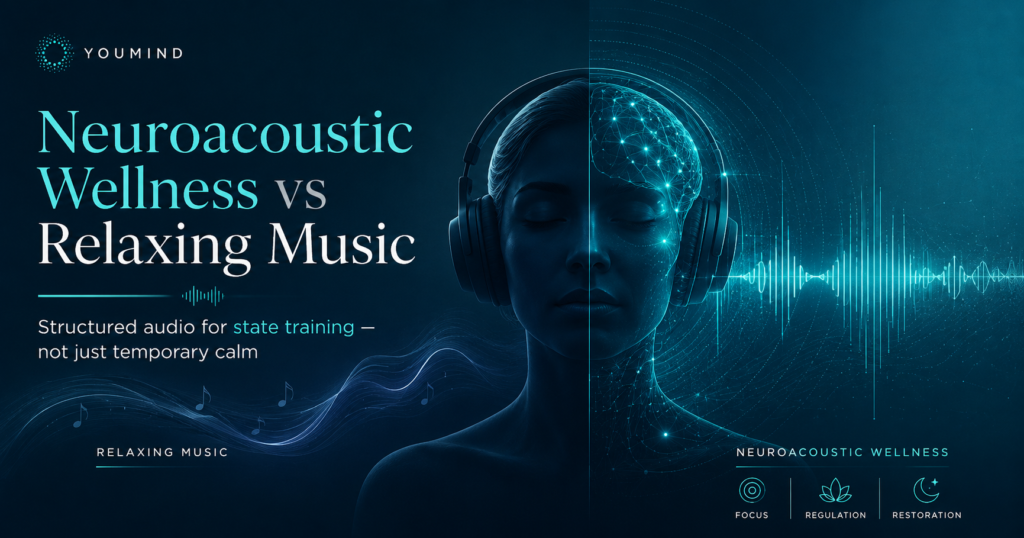
Relaxing music is mainly designed to feel pleasant and calming. Neuroacoustic wellness is designed around a specific outcome: helping the listener repeatedly access states such as calm, focus, emotional recovery or sleep preparation through structured audio protocols.
If you’ve ever listened to ocean waves, calming piano music, or nature sounds after a stressful day, you’ve already experienced how music can influence your mood. Relaxing music has helped millions of people unwind, sleep better, or simply enjoy a moment of peace.
So why do we use the term neuroacoustic wellness instead of simply saying “relaxing music”? Because they are designed with very different goals.
Relaxing music is created to produce a pleasant listening experience. Neuroacoustic wellness is designed to help you intentionally reach a specific mental state,and, more importantly, train your brain to reach that state more easily over time.
This difference is what makes neuroacoustic wellness unique.
What Is Neuroacoustic Wellness?
Neuroacoustic wellness uses carefully designed audio experiences to support specific states such as relaxation, deep sleep preparation, focus, emotional recovery or mental clarity.
At YouMind, neuroacoustic wellness is delivered through neuroacoustic protocols: structured playlists of audio sessions designed around a specific goal. Instead of random calming tracks, the listener follows a progression where each session has a purpose.
A neuroacoustic protocol is a structured playlist of audio sessions designed around a specific objective. Instead of listening to random relaxing tracks, you follow a sequence of sessions that work together to help you repeatedly access the same desired state.
Think of it like following a fitness program.
One workout rarely transforms your body.
Progress comes from repeating the right exercises in the right order over time.
Neuroacoustic wellness follows the same principle. Each track has a purpose, and together they form a structured training program for the brain.
Relaxing Music Helps You Feel Better
Relaxing music can be useful. The NIH/NCCIH overview of music and health explains that music-based approaches may include listening, singing, performance and other forms of engagement. Many people use music to unwind, sleep better or create a calmer environment.
Whether it’s classical music, soft ambient sounds, or gentle acoustic melodies, relaxing music creates an enjoyable emotional experience that many people use to reduce stress or create a peaceful atmosphere.
For many people, that’s exactly what they need.
But relaxing music is generally created to sound beautiful and calming.
It is not usually designed around a structured process with a specific training objective.
Neuroacoustic Wellness Begins with the Desired State
Neuroacoustic wellness starts with a different question. Instead of asking,
“What sounds relaxing?”
it asks,
“What state is this person trying to achieve?”
Someone preparing for sleep has different needs than someone preparing for an important meeting.
Someone recovering from emotional exhaustion requires a different experience than someone trying to improve concentration. For this reason, different goals require different neuroacoustic protocols.
One structured playlist may be designed to support deep sleep. Another may focus on cognitive clarity.
Another may help someone transition from chronic stress toward a calmer, more balanced state. The objective determines the playlist,not the other way around.
The Main Difference: Temporary Relief Vs State Training
| Comparison point | Relaxing music | Neuroacoustic wellness |
| Primary question | What sounds calming? | What state do we need to support? |
| Structure | Usually aesthetic or mood-based | Goal-based sequence of sessions |
| Personalization | Usually generic | Can adapt to the user’s profile and objective |
| Short-term effect | Pleasant relief or atmosphere | Targeted support for focus, calm, recovery or sleep preparation |
| Long-term aim | Enjoyment and relaxation | Repeated practice of healthier states |
What Is State Optimization?
Our brains naturally move through different states throughout the day.
Sometimes we feel energetic, sometimes mentally exhausted, sometimes focused and sometimes overwhelmed.
State optimization is the practice of intentionally helping your brain move toward the state that
best supports what you need in that moment.
For example, before going to sleep, your ideal state is very different from the state you need before giving an important presentation or beginning several hours of deep work.
Rather than treating every situation with the same relaxing music, neuroacoustic wellness recognizes that different situations require different mental states.
A Protocol Is More Than a Playlist
Although a neuroacoustic protocol is a playlist, it is not simply a collection of relaxing tracks.
Every playlist is intentionally designed around a specific goal. Each audio session builds upon the previous one, creating a structured progression rather than a random listening experience.
Just as a personal trainer selects exercises based on your objective, a neuroacoustic protocol selects audio sessions based on the state you want to develop.
This is why we refer to it as a protocol instead of simply calling it a playlist. The playlist follows a purpose.
The goal is to train access to better states
The goal is not lifelong dependence on headphones. The goal is to help the brain and body become more familiar with useful states: calm, focus, emotional balance and restorative sleep preparation. Research on experience-dependent neural plasticity supports the broader idea that repeated experiences can influence learning and adaptation.
This is where neuroacoustic wellness moves beyond background relaxation. It becomes a structured practice for state optimization. For deeper technical context, readers can visit YouMind’s brain entrainment science page.
Why Personalization Matters
No two people experience stress in exactly the same way. One person struggles to quiet racing thoughts. Another feels physically tense. Someone else feels emotionally drained despite appearing calm on the outside.
Because everyone’s starting point is different, the same playlist will not necessarily produce the same experience for everyone.
This is why personalized neuroacoustic wellness is becoming increasingly important.
By understanding an individual’s goals and current state, it becomes possible to recommend protocols that are more closely aligned with what they actually need.
Supporting Long-Term Well-Being
Modern life places constant demands on our attention. Notifications.
Meetings. Social media. Deadlines.
Information overload.
Our brains rarely have the opportunity to recover.
Neuroacoustic wellness introduces intentional periods where the brain can practice moving into healthier, more balanced states through structured listening experiences.
Rather than simply escaping stress for a few minutes, the objective is to strengthen your ability to regulate your own mental state over time.
That is a very different philosophy from simply listening to relaxing background music.
Is neuroacoustic wellness scientifically proven?
The responsible answer is: the underlying fields are supported by research, while any specific integrated system should be evaluated with appropriate boundaries. Studies have examined music-based interventions, auditory stimulation, brainwave entrainment, autonomic regulation and subjective mental states. For example, a JAMA Network Open systematic review found music interventions associated with improvements in health-related quality of life, while research on auditory driving of the autonomic nervous system explores how auditory stimulation may relate to autonomic recovery contexts.
For YouMind, this is why the language should stay precise: neuroacoustic wellness is designed to support state optimization. It is not a medical diagnosis, treatment or cure.
The Future of Wellness Is Training, Not Temporary Relief
Wellness is evolving.
People increasingly want solutions that help them build lasting skills rather than providing only temporary relief.
That is exactly where neuroacoustic wellness differs from traditional relaxing music.
Instead of creating pleasant sounds alone, it uses structured neuroacoustic protocols,purposefully designed playlists,to support state optimization and help train the brain through repeated practice. The objective is simple. Help people sleep better. Recover more effectively. Focus more deeply. Feel emotionally balanced.
And ultimately become less dependent on external tools because their brains have learned how to reach these states more naturally.
Conclusion
Relaxing music and neuroacoustic wellness both have value, but they are not the same. Relaxing music is designed to create a pleasant emotional experience.
Neuroacoustic wellness is designed to help people intentionally reach specific mental states through structured neuroacoustic protocols,carefully designed playlists that guide the brain through repeated practice.
Over time, the goal is not simply to relax while listening.
The goal is to train the brain so that calmness, focus, emotional balance, and restorative sleep become increasingly accessible in everyday life.
At YouMind, the future of wellness is not just feeling better for a moment. It is learning how to access the right state more reliably. Explore YouMind solutions or contact the YouMind team to learn how personalized protocols work.
FAQ
Is neuroacoustic wellness the same as relaxing music?
No. Relaxing music is usually designed to create a pleasant mood. Neuroacoustic wellness is designed around a specific outcome, such as focus, calm, emotional recovery or sleep preparation.
Can relaxing music still be useful?
Yes. Relaxing music can help people unwind and create a calmer environment. Neuroacoustic wellness simply adds structure, intention and personalization.
Why does YouMind call it a protocol?
Because the sessions are arranged in a purposeful order. A protocol is a structured pathway, not a random playlist.
Do I need headphones?
Some neuroacoustic methods use headphones for precise stereo delivery. Usage instructions should follow the specific protocol and safety guidance provided by YouMind.
Is neuroacoustic wellness medical treatment?
No. It is a wellness and performance support approach. It should not replace medical advice, diagnosis or treatment.
Share this article