Mechanistic Plausibility DossierExecutive Performance Architecturev1.0

The YouMind Clinical Architecture of executive performance.

A literature-grounded examination of 37 foundational studies detailing the theoretical and mechanistic underpinnings of auditory entrainment, autonomic regulation via vocal biomarkers, and the central nervous system's critical role in cognitive flexibility and executive performance.

Critical boundary statement

Mechanistic plausibility — not integrated clinical validation.

The cited literature supports the underlying physiological and neurological mechanisms relevant to the YouMind approach. It does not, individually or collectively, constitute direct clinical validation of the integrated YouMind system.

This document establishes the mechanistic plausibility of the system's isolated components — the architecture of what is scientifically known, and precisely where the claim boundaries lie.

The YouMind neuro-acoustic infrastructure is informed by established neurophysiology. This dossier compiles 37 foundational studies detailing the theoretical and mechanistic underpinnings of auditory entrainment, autonomic regulation via vocal biomarkers, and the central nervous system's critical role in cognitive flexibility and executive performance.

High-order cognitive coaching cannot effectively penetrate a brain locked in a biological state of survival. Autonomic downregulation must occur first.

The evidence assembled spans three interconnected domains: the output science of acoustic neuromodulation, the input science of vocal biomarkers, and the integration science of cognitive flexibility and executive function. Together they form a coherent mechanistic model — not a single causal chain, but a layered, defensible architecture of plausibility.

Evidence hierarchy guide.

All citations are graded by study design hierarchy. Tier classification is based on study design, not on effect size, sample size, or replication status.

A
High Strength
Meta-Analyses / Systematic Reviews / RCTs

Highest evidentiary weight. Aggregates multiple controlled studies or employs randomised controlled trial methodology.

B
Moderate Strength
Controlled Experimental / in vivo

Controlled laboratory conditions with measurable physiological outputs. Causal inference possible within constraints.

C
Foundational / Conceptual
Literature Reviews / Theoretical Frameworks

Organizing frameworks, anatomical mapping, and comprehensive narrative reviews. Conceptual scaffolding.

D
Hypothesis Generating
Pilot Studies / Exploratory Data

Early-stage signals. Insufficient power for confirmation but directionally suggestive. Informs future study design.

03

Acoustic Neuromodulation & EEG Entrainment (The "Output" Science)

Establish the mechanistic plausibility of rhythmic auditory stimulation as a tool for targeted neural oscillation.

CIT-01 CComprehensive Review

A comprehensive review of the psychological effects of brainwave entrainment.

Huang, T. L., & Charyton, C. (2008)

Mechanistic Plausibility: Is consistent with the baseline hypothesis that acoustic entrainment correlates with altered cognitive states under controlled conditions.
Inference:Correlational Applicability:Indirect (Component Level)
CIT-02 BControled Experimental

Human auditory steady-state responses

Picton, T. W., et al. (2003)

Mechanistic Plausibility: Demonstrates the existence of the Frequency Folowing Response (FFR), confirming the brain predictably synchronizes dominant frequencies to steady acoustic rhythms
Inference:Causal under controled conditions Applicability:Direct (Mechanism Level)
CIT-03 BNeuroimaging Experimental

Activation of Human Cerebral and Cerebelar Cortex by Auditory Stimulation at 40 Hz.

Pastor, M. A., et al. (2002)

Mechanistic Plausibility: Demonstrates that specific acoustic rhythms act as active neurophysiological stimuli, physica ly engaging cortical networks.
Inference:Causal physiological response Applicability:Direct (Mechanism Level)
CIT-04 BControled Experimental

Auditory driving of the autonomic nervous system..

McConnell, P. A., et al. (2014)

Mechanistic Plausibility: Indicates that theta frequencies are associated with post-exertion parasympathetic activation, aligning with YouMind's "Theta Bridge" architecture.
Inference:Correlational Applicability:Indirect (Component Level)
CIT-05 CLiterature Review

Auditory beat stimulation and its effects on cognition and mood states

Chaieb, L., et al. (2015)

Mechanistic Plausibility: Is consistent with the deployment of higher-frequency (SMR/Beta) tracks for cognitive neuromotor priming
Inference:Correlational Applicability:Indirect
CIT-06 CLiterature Review

Effects of binaural beats and isochronic tones on brain wave modulation.

Aparecido-Kanzler, S., et al. (2021)

Mechanistic Plausibility: Enables the hypothesis that isochronic entrainment can be feasibly deployed via ambient room speakers rather than isolated headphones.
Inference:Conceptual Analysis Applicability:Indirect (Delivery Vector)
CIT-07 CTheoretical Framework / Review

Neural Entrainment and Attentional Selection in the Listening Brain.

Obleser, J., & Kayser, C. (2019)

Mechanistic Plausibility: Enables the hypothesis that entrained neural osci lations may act as an attentional filter, modulating how physical stimuli are perceived.
Inference:Theoretical Applicability:Indirect
CIT-08 B(EEG Experimental

Brain wave synchronization and entrainment to periodic acoustic stimuli.

Will, U., & Berg, E. (2007)

Mechanistic Plausibility: Demonstrates precise neural alignment to periodic acoustic stimuli via EEG validation.
Inference:Causal physiological response Applicability:Direct (Mechanism Level)
CIT-09 DPilot Study

Use of binaural beat tapes for treatment of anxiety: a pilot study.

Le Scouarnec, R. P., et al. (2001)

Mechanistic Plausibility: Indicates early-stage plausibility for acoustic entrainment as a supportive tool for baseline anxiety reduction
Inference:Exploratory / Correlational Applicability:Indirect
CIT-10 BControled Experimental / EEG

Gamma-band activity reflects the metric structure of rhythmic tone sequences.

Snyder, J. S., & Large, E. W. (2005)

Mechanistic Plausibility: Demonstrates that neural activity anticipates steady tone onsets and persists even when expected tones are omitted, validating the architectural reliance on predictable pulses to establish cognitive anchoring.
Inference:Causal physiological response Applicability:Indirect (Structural Design)
CIT-11 Bin vivo Experimental

Coordinated infraslow neural and cardiac oscilations mark fragility...

Lecci, S., et al. (2017)

Mechanistic Plausibility: Is consistent with the conceptual mapping of Deep Delta (0.5-4Hz) protocols to autonomic downregulation processes
Inference:Correlational (Highly coupled) Applicability:Indirect (Component Level)
CIT-12 ARCT

A prospective, randomised, controled study examining audio entrainment...

Padmanabhan, R., et al. (2005)

Mechanistic Plausibility: Demonstrates that acoustic protocols can attenuate physiological stress prior to acute physical interventions.
Inference:Causal clinical outcome Applicability:Indirect (Pre-intervention setting)
CIT-13 ARCT

Effects of music therapy on autonomic nervous system regulation and anxiety in patients undergoing orthopedic surgery.

Wu, P. Y., Huang, M. L., Lee, W. P., Wang, C., & Shih, W. M. (2017)

Mechanistic Plausibility: Demonstrates that structured acoustic stimuli (music therapy) significantly decreases anxiety and stabilizes autonomic nervous system activity—specifica ly Heart Rate, Blood Pressure, and HRV—in high-stress environments. This provides high-strength evidentiary support for the system's reliance on acoustic interventions for central nervous system regulation
Inference:Causal clinical outcome Applicability:Direct (Mechanism Level)
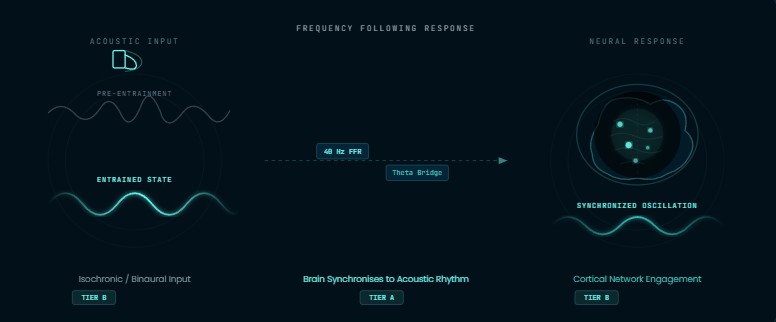
Figure 01 — Neural Entrainment Mechanism
From raw vocal waveform through laryngeal-vagal coupling to extracted prosodic markers
The Frequency Following Response (FFR): the brain predictably synchronises its dominant oscillatory frequencies to steady acoustic rhythms. This is not theoretical — it is measurable via EEG under controlled conditions (Picton et al., 2003; Will & Berg, 2007). The implication is that deliberately structured acoustic environments can shift the brain's operational frequency band.
04

Vocal Biomarkers & The Autonomic Nervous System Vocal Biomarkers & The Autonomic Nervous System

Outline the literature supporting vocal markers as correlates of affective and autonomic states, serving as a physiological complement to subjective reporting.

CIT-14 BBehavioral Experimental

Voice-only communication enhances empathic accuracy

Kraus, M. W. (2017)

Mechanistic Plausibility:Demonstrates that relying solely on vocal cues increases accurate affective detection, supporting the Triangulation Protocol’s mandate to cross-reference text with voice.
Inference:Correlational Applicability:Indirect (Protocol Justification)
CIT-15 CTheoretical Framework

Orienting in a defensive world: A Polyvagal Theory

Porges, S. W. (1995)

Mechanistic Plausibility: Used as an organizing framework—not a validated diagnostic model—providing a biological taxonomy to map user stress to distinct phylogenetic states.
Inference:Conceptual Model Applicability:Indirect (System Logic)
CIT-16 CTheoretical Review

The polyvagal theory: phylogenetic substrates of a social nervous system.

Porges, S. W. (2001)

Mechanistic Plausibility: Demonstrates the anatomical innervation of the laryngeal muscles by vagal pathways, providing a structural link between vocal tone and autonomic state.
Inference:Anatomical Mapping Applicability:Direct (Mechanism Level)
CIT-17 CComprehensive Review

Vocal communication of emotion: A review of research paradigms.

Authors (year)

Mechanistic Plausibility:Demonstrates the anatomical innervation of the laryngeal muscles by vagal pathways, providing a structural link between vocal tone and autonomic state.
Inference:Anatomical Mapping Applicability:Direct (Mechanism Level)
CIT-18 BObservational Experimental

Vocal indicators of affective disorders.

Scherer, K. R., et al. (2001)

Mechanistic Plausibility: Indicates that involuntary acoustic markers can contradict explicit semantic claims (supporting the concept of "masked distress").
Inference:Correlational Applicability:Indirect (Component Level)
CIT-19 AMeta-Analysis

Communication of emotions in vocal expression and music performance: Different channels, same code?

Juslin, P. N., & Laukka, P. (2003)

Mechanistic Plausibility: Provides established meta-analytic mapping matrices for translating raw acoustic features (e.g., pitch, intensity, rhythm) into specific internal affective states
Inference:Indirect (Algorithm Design) Applicability:Component-level
CIT-20 BControlled Experimental

The role of perceived voice and speech characteristics in vocal emotion communication.

Bänziger, T., Patel, S., & Scherer, K. R. (2014)

Mechanistic Plausibility: Demonstrates that perceived voice characteristics (suprasegmental and spectral cues) carry significant affective weight in emotion recognition, even when semantic content is absent (using pseudo-speech).
Inference:Correlational Applicability:Indirect
CIT-21 AMeta-Analysis

What do we really know about blunted vocal affect and alogia? A meta-analysis of objective assessments.

Cohen, A. S., Mitchell, K. R., & Elvevåg, B. (2014).

Mechanistic Plausibility: Demonstrates the presence of reliable, quantifiable acoustic markers (e.g., pause behavior) in speech that correlate with internal states, supporting the feasibility of augmenting subjective intake forms with objective metrics in non-diagnostic contexts.
Inference:Strong Correlational / Meta-Analytic Applicability:Direct (Assessment Tool)
CIT-22 BObservational Experimental

The covariation of acoustic features of infant cries and autonomic state.

Stewart, A. M., Lewis, G. F., Heilman, K. J., et al. (2013).

Mechanistic Plausibility: Demonstrates a robust covariation between vocal prosody (pitch modulation, fundamental frequency) and autonomic state (RSA and heart rate) in infants, supporting the hypothesis that vocalization provides an involuntary, biological index of the nervous system.
Inference:Correlational Applicability:Indirect
CIT-23 CMethodological Review

Vocal expression of affect.

Juslin, P. N., & Scherer, K. R. (2005).

Mechanistic Plausibility: Demonstrates that YouMind’s acoustic assessment frameworks align with established scientific measurement paradigms.
Inference:Methodological Standard Applicability:Indirect
CIT-24 BControled Experimental

Effects of singing on autonomic nervous system regulation.

Stegemöller, E. L., et al. (2017)

Mechanistic Plausibility: Enables the hypothesis that the act of completing a vocal intake may initiate a minor regulatory shift.
Inference:Correlational Applicability:Exploratory
CIT-25 BNeuroimaging Experimental

Decoding of emotion from voices in human right superior temporal cortex.

Authors (year)

Mechanistic Plausibility: Demonstrates the neurobiological hardwiring for extracting emotional data from vocal prosody, identifying the right superior temporal cortex as a key node for decoding affective vocalizations.
Inference:Causal physiological response Applicability:Conceptual
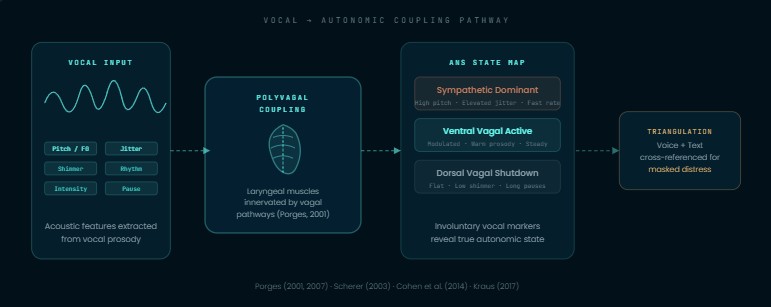
Figure 02 — The Vocal–Autonomic Coupling Model
From raw vocal waveform through laryngeal-vagal coupling to extracted prosodic markers
The vocal-autonomic coupling model: vocal prosody is not merely a communication medium — it is an involuntary, biological readout of the autonomic nervous system. Laryngeal muscles are innervated by vagal pathways (Porges, 2001), meaning the voice carries objective physiological data that semantic content cannot mask. YouMind's Triangulation Protocol cross-references vocal biomarkers with text-based intake to surface hidden states.
05

Cognitive Flexibility & Executive Function (The "Modality Integration" Science)

Highlight literature establishing the necessity of autonomic downregulation and physiological regulation as a biological prerequisite for effective organizational training, executive coaching, and sustainable behavioral change.

CIT-26 CComprehensive Review

Stress signalling pathways that impair prefrontal cortex structure and function.

Arnsten, A. F. T. (2009).

Mechanistic Plausibility: Demonstrates that sympathetic overdrive and catecholamine excess (stress) actively impair Prefrontal Cortex (PFC) function. This establishes the baseline architectural premise that high-order cognitive coaching and behavioral training cannot effectively penetrate a brain locked in a biological state of survival; autonomic downregulation must occur first.
Inference:Conceptual Model Applicability:Direct (Protocol Rationale)
CIT-27 AMeta-Analysis / Systematic Review

Heart rate variability, prefrontal neural function, and cognitive performance: the neurovisceral integration perspective.

Thayer, J. F., et al. (2009).

Mechanistic Plausibility: Demonstrates that higher vagal tone (measured via HRV) is inextricably linked to superior executive function, working memory, and emotional regulation.
Inference:Strong Correlational Applicability:Direct (Systemic Claims)
CIT-28 BNeuroimaging Experimental

Stress-related noradrenergic activity prompts large-scale neural network reconfiguration.

Hermans, E. J., et al. (2011).

Mechanistic Plausibility: Demonstrates that acute systemic stress physically shifts brain connectivity away from the executive control network and toward the salience (reactive) network. This illustrates why traditional behavioral interventions frequently fail to yield long-term ROI during periods of unmanaged organizational stress.
Inference:Causal physiological response Applicability:Indirect (Integration Strategy)
CIT-29 CTheoretical Framework

Brain on stress: how the social environment gets under the skin.

McEwen, B. S. (2012).

Mechanistic Plausibility: Indicates that chronic allostatic load induces structural remodeling in the amygdala, driving cognitive rigidity and a "defensive" posture.
Inference:Conceptual Model Applicability:Direct (Protocol Rationale)
CIT-30 BControlled Experimental / fMRI

Examination of the neural substrates of coaching…

Boyatzis, R. E., et al. (2015).

Mechanistic Plausibility: Indicates that coaching geared toward parasympathetic activation (visioning, safety) engages neural circuits associated with behavioral change and openness, whereas stress-inducing environments trigger sympathetic defense mechanisms that block learning.
Inference:Correlational Applicability:Direct (Algorithm Mapping)
CIT-31 CFoundational Review

The brain's default mode network.

Raichle, M. E. (2015).

Mechanistic Plausibility: Is consistent with the architecture's focus on mitigating the "24-Hour Vigilance Loop." When a corporate environment prevents the brain from entering offline consolidation within the Default Mode Network, strategic visioning degrades.
Inference:Theoretical Applicability:Exploratory (Protocol Rationale)
CIT-32 ASystematic Review

Heart Rate Variability and Cognitive Function: A Systematic Review.

Forte, G., Favieri, F., & Casagrande, M. (2019).

Mechanistic Plausibility: Confirms across a comprehensive dataset that higher Heart Rate Variability (indicative of parasympathetic dominance) is strictly positively correlated with superior executive function, sustained attention, and cognitive flexibility.
Inference:Systematic Review Applicability:Systematic Review
CIT-33 BControlled Experimental

Psychosocial stress reversibly disrupts prefrontal processing and attentional control.

Liston, C., McEwen, B. S., & Casey, B. J. (2009).

Mechanistic Plausibility: Demonstrates that chronic psychosocial stress disrupts architectural connectivity in the Prefrontal Cortex. Crucially, the study proves this impairment is reversible, validating the YouMind approach of utilizing neuro-acoustic tools to restore baseline biological regulation.
Inference:Causal physiological & cognitive outcome Applicability:Causal physiological & cognitive outcome
CIT-34 BNeuroimaging Experimental / fMRI

Visioning in the brain: an fMRI study of inspirational coaching and mentoring.

9. Jack, A. I., et al. (2013).

Mechanistic Plausibility: Demonstrates via fMRI that "compassionate coaching" activates the global networks associated with visionary thinking. Conversely, coaching focused on "fixing weaknesses" activates defense networks, physically shutting down neural pathways required for learning.
Inference:Correlational neuro-activation Applicability:Direct (Integration Strategy)
CIT-35 BControlled Experimental

Vagal influence on working memory and attention.

Hansen, A. L., Johnsen, B. H., & Thayer, J. F. (2003).

Mechanistic Plausibility: Shows that individuals with higher baseline vagal tone perform significantly better on continuous performance tests and working memory tasks.
Inference:Causal cognitive outcome Applicability:Direct (Mechanism Level)
CIT-36 CLiterature Review

Decision making under stress: a selective review.

Starcke, K., & Brand, M. (2012).

Mechanistic Plausibility: Reviews how acute and chronic stress reliably shifts decision-making away from analytical, goal-directed behavior and toward habitual, reward-driven, and rigid heuristics.
Inference:Conceptual Model Applicability:Direct (Protocol Rationale)
CIT-37 CTheoretical Framework

The polyvagal perspective.

Porges, S. W. (2007).

Mechanistic Plausibility: Establishes the Polyvagal Theory, detailing how the myelinated ventral vagus nerve acts as a "social engagement system." It shows that trust and team cohesion are nearly physically impossible when the brain's "neuroception" of safety is offline.
Inference:Foundational Mechanism Applicability:Foundational (Algorithm Mapping)

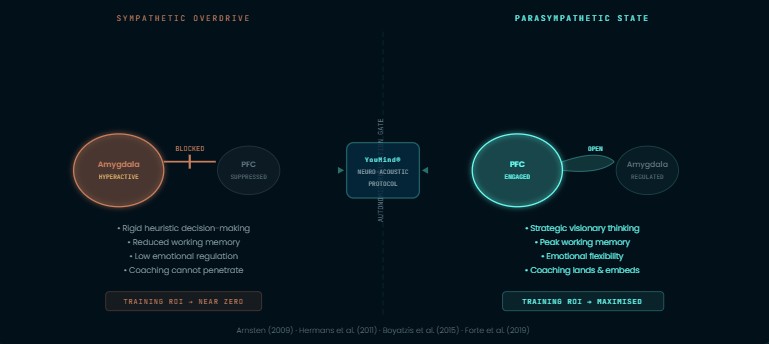
Figure 04 — The Stress-Cognition Gate
From raw vocal waveform through laryngeal-vagal coupling to extracted prosodic markers
The central architectural premise: sympathetic overdrive physically impairs Prefrontal Cortex function (Arnsten, 2009). Traditional behavioural interventions frequently fail to yield long-term ROI during periods of unmanaged organizational stress because the brain's executive networks are physiologically offline. The YouMind protocol functions as a prerequisite regulation layer — not a replacement for coaching, but the biological condition under which coaching can land.
06
Section Six · Operational Evidence Layer

Applied observational dataset — real-world conditions.

Structured observational data collected across 50 individual sessions within live hospitality environments — used as a high-variability proxy for evaluating whether the system can induce state transition under load.

Boundary Statement: This dataset does not constitute controlled clinical validation. It represents structured observational data collected across 50 individual sessions within live hospitality environments. Participants entered in variable — and often elevated — autonomic states and were exposed to standardised YouMind neuro-acoustic protocols. The purpose of this dataset is not to establish causality, but to assess whether consistent directional physiological and behavioural signals emerge under applied conditions.
Sample Size
n=50
Environment
Premium Hospitality / Spa Settings
Median Onset
~5 min
Contextual Framing

Hospitality environments were used as high-variability, real-world test conditions, characterised by: elevated baseline stress (travel fatigue, cognitive overload, physical discomfort), low compliance tolerance (cold exposure, floatation, deep tissue work), and uncontrolled external variables. This context is relevant not as a use case, but as a proxy environment for evaluating whether the system can induce state transition under load — directly analogous to organizational stress conditions.

01

Consistent Directional Downregulation

  • Participants demonstrate repeated directional shifts consistent with autonomic downregulation across heterogeneous individuals and contexts
  • Agitation → calm / grounded states across multiple sessions
  • Cognitive noise → perceptual quieting observed consistently
  • Anxiety / resistance → physiological settling — non-random signal emergence
02

Rapid Time-to-Effect

  • Observed effects commonly emerge within minutes of exposure — operationally significant where attention windows are limited
  • Median reported onset approximately 5 minutes (directional estimate based on available entries)
  • This rapid onset is critical in environments where compliance thresholds are low and intervention time must be minimal
03

Behavioural Compliance Shift

  • Sustained engagement with previously resisted modalities (cold plunge, floatation)
  • Reduced urge to exit or interrupt experiences mid-session
  • Increased tolerance for discomfort — observable behavioural override of avoidance patterns
  • The signal is not limited to subjective relaxation — it includes measurable behavioural change
04

Cognitive State Modulation

  • Reduction in internal dialogue / rumination — frequently self-reported
  • Increased present-state awareness during and following protocol exposure
  • Perceived "mental quieting" — consistent with transition into receptive states
  • Observations align with the system's intended role in reducing cognitive load and enabling transition for higher-order processing
State Transition Mapping (Observed Patterns)
Baseline State Observed Post-State
Agitated / overstimulated Calm / settled
Anxious / anticipatory Grounded / safe
Resistant / avoidant Cooperative / compliant
Cognitively noisy Quiet / present
Representative Verbatim Signals

I usually panic and jump out… but this time I stayed.

I came in wired from a stressful meeting… within minutes everything slowed down.

Normally I can't switch off in hotels… this was the first time my mind actually went quiet.

I expected to resist it, but I didn't feel the need to leave.

Relevance to Executive & Organizational Contexts

While derived from hospitality environments, the relevance is structural, not contextual. The core observation is the ability to induce state transition in a nervous system under load. This directly maps to a known constraint in executive performance: high-level coaching, training, and strategic cognition cannot effectively engage when the system is in a defensive (sympathetic-dominant) state.

The dataset therefore supports the hypothesis that physiological regulation may be a prerequisite layer for effective leadership development and organizational intervention.

07
Appendix A · System Conceptual Boundaries

Layered architecture & claim demarcation.

To clarify the extent of empirical support, the YouMind architecture is strictly demarcated into three conceptual layers — separating what is validated from what is engineered and what remains an open empirical question.

Figure 04 — The Three-Layer Defensibility Architecture
LAYER 01 Validated Mechanisms Literature-backed component physiology. FFR exists. Vagal tone correlates with vocal prosody. SUPPORTED BY THIS DOSSIER LAYER 02 System Architecture Proprietary combination and deployment via YouMind algorithms. Structural engineering, not biology. PROPRIETARY ENGINEERING LAYER 03 Physiological Outcomes Integrated effect on end-users. Reduced stress, improved executive function. Requires separate empirical validation. VALIDATION REQUIRED
The defensibility argument, visualised. Layer 01 is supported by the citations in Sections 1–3. Layer 02 is proprietary engineering on top. Layer 03 — the integrated end-user outcome — requires separate empirical validation and is currently directionally suggested, not clinically validated. We name this gap explicitly because honesty is the only viable scientific posture.
Layer 1

Validated Mechanisms

Literature-backed component physiology. Auditory entrainment, vocal-autonomic coupling, prefrontal cortex regulation via HRV — each individually supported by the cited literature in this dossier.

Layer 2

System Architecture

The proprietary deployment of these mechanisms via YouMind algorithms — frequency sequencing, isochronic patterning, voice-driven personalisation, and ambient delivery vectors. Structural engineering on top of validated science.

Layer 3

Physiological Outcomes

The integrated effect on the end-user. Requires separate empirical validation — directionally suggested by the Section 4 observational dataset but not yet established through controlled clinical trial.

06
Appendix B · Claim Traceability Matrix

Core claims mapped to their highest-tier evidence.

Each architectural claim of the YouMind system mapped directly to its primary evidentiary support, evidence grade, and inference type — enabling transparent due diligence review.

YouMind Component Claim Primary Evidentiary Support Evidence Grade Evidence Type
Output: The brain will synchronise to steady acoustic rhythms. Picton et al. (2003) Tier B Causal under controlled conditions
Output: Rhythmic audio physically activates the cerebral cortex. Pastor et al. (2002) Tier B Causal physiological response
Input: The laryngeal muscles are innervated by vagal (autonomic) pathways. Porges, S. W. (2001) Tier C Anatomical Mapping
Input: Vocal acoustic features can objectively measure emotional state. Cohen et al. (2014) Tier A Strong Correlational / Meta-Analytic
Input: Voice contains more accurate affective data than text / visuals. Kraus, M. W. (2017) Tier B Correlational
Integration: Executive function requires sympathetic downregulation. Arnsten, A. F. T. (2009) Tier C Conceptual Model
Integration: Vagal tone (HRV) correlates with cognitive flexibility. Thayer, J. F., et al. (2009) Tier A Strong Correlational
Conclusion

Conclusion Individual components firmly grounded in empirical science, paired with applied observational data demonstrating directional state transition under load.

The architecture detailed above demonstrates that the individual components of the YouMind technology are firmly grounded in established, empirical science. The cited literature supports the underlying physiological and neurological mechanisms across three integrated domains — acoustic neuromodulation, vocal biomarker extraction, and executive cognitive function.
Paired with applied observational data demonstrating directional state transition under real-world conditions (n=50), this dossier establishes mechanistic coherence and signal validity, rather than definitive clinical efficacy.
The operational implication for executive performance contexts is direct: high-level coaching, training, and strategic cognition cannot effectively engage when the system is in a defensive, sympathetic-dominant state. The YouMind architecture is positioned as the regulation layer that enables the conditions under which existing executive development interventions can operate with maximum neurological receptivity and sustained ROI.
— End of dossier · YouMind® Executive Performance Architecture · v1.0 · Prepared for Korn Ferry due diligence

Discuss the integration for your facility.